
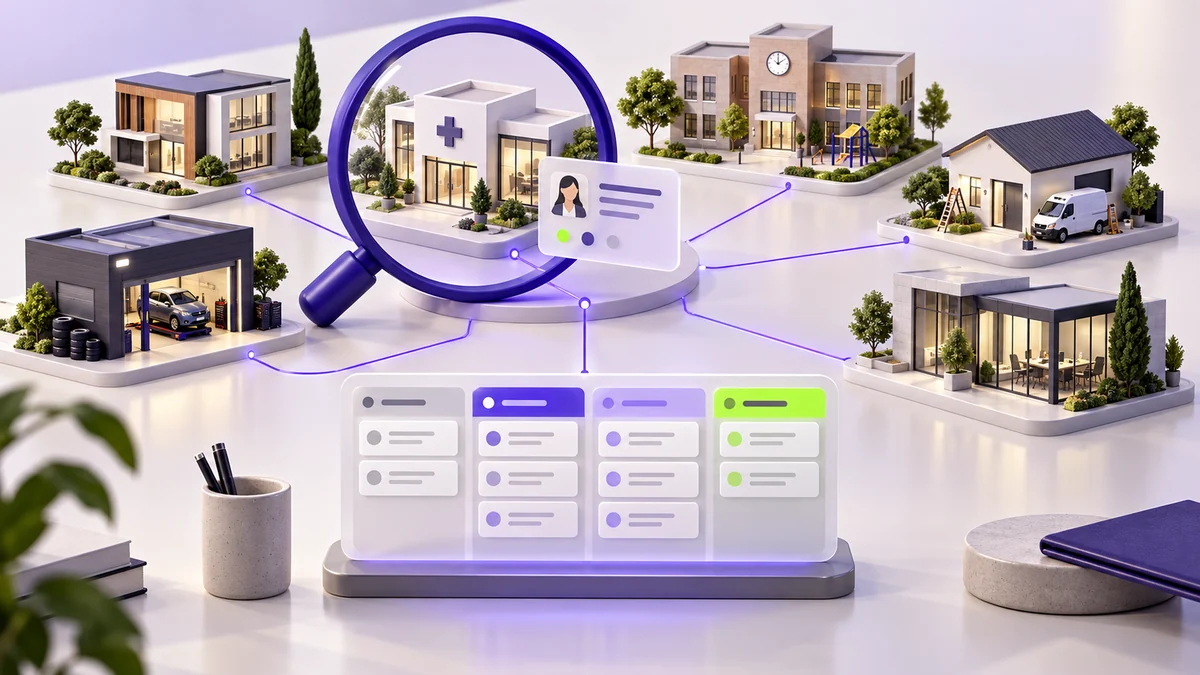
Capture customers for a white-label CRM starts before the platform is presented. It starts when you can answer three questions: Which company is worth addressing, which business problem needs to be solved and who is willing to change the routine to solve it?
The owner of a workshop does not buy for the same reasons as the manager of a school. Both may need to follow the opportunities, but the language, the timing of the decision and the demonstration must reflect each operation. This guide helps you choose an approach, investigate the pains and conduct an advisory sale with the beginning, middle and next step.
If you are still structuring your offer, read also How the white-label CRM works. Aquí, el enfoque es realizar la captación con criterio.
1. Nicho is the starting point. The ideal profile is the filter.
A useful cut would be: clinics with more than one person in the care, frequent search for services, and reported difficulty in tracking requests to programming. This profile describes an operation in which you can investigate a specific problem.
The ideal customer profile, the ICP, combines the segment, the business routine, the need and the ability to deploy. A company with many followers may not have an organized demand, a budget or someone available to lead the change. Another, smaller and less known, may have an urgent problem and a committed responsible.
Write your cut-off in a sentence: "Help [type of company] facing [confirmed problem] to organize [process], accompanying [indicator]." For example: "Helping language schools that lose track of stakeholders to organize the process between first contact and registration."
First choose a main and an alternative segment. This makes it easy to learn vocabulary, recognize objections and reuse a coherent demonstration. Expand after understanding why companies buy, postpone or reject.
2. Eight niches: pains to investigate and how to present value
The situations below are Diagnosis possibilities, not problems that each company in the sector presents. Confirm each pain with the responsible. Also valid if the necessary features and integrations are available in the configuration you offer.
Dental clinics and clinics
Pain to investigate: Stakeholders ask for information, talk to different people and stay unreturned until the appointment. Ask how the reception identifies who is still waiting for an answer and who needs confirmation.
Who is involved: owner or administrative manager and leadership of the reception. Shows a stream of interest received, contact made, programming pending and scheduled, with responsible and next action.
Indicator: The focus of the presentation is the business organization and the agenda; use fictitious data and do not include records or clinical information in the demonstration.
Real estate and brokerage equipment
Pain to investigate: a consultation about a property arrives, passes to a broker and the manager loses visibility of the return. Active ads and several brokers are signs to investigate the company, but do not prove a lack of attention.
Who is involved: owner of the real estate or business manager. Shows the entry of the opportunity, allocation, registration of preferences, visit and follow-up. Each opportunity must have a responsible and a marked action.
Indicator: Open opportunities without next total action of open opportunities. The proposal may be to organize the distribution and follow-up of stakeholders. Do not attribute to the CRM control over the offer of real estate, credit or final decision of the buyer.
Language schools and vocational courses
Pain to investigate: Interested in different courses and shifts are mixed as the registration deadline progresses. Ask what happens when someone asks for information and says they will decide later.
Who is involved: Shows the funnel of interest, qualification, visit or experimental class and registration, registering course, class and time of decision.
Indicator: Completed registrations qualified stakeholders of the same campaign or period of entry. Also follow up on returns made within the combined time frame. Avoid mixing different courses and durations campaigns in the same comparison.
Offices and automotive aesthetics
Pain to investigate: The submitted quotes remain untracked, or the customer must explain the service again when he changes assistant. Find out who gives him outstanding bids and how the return is recorded.
Who is involved: owner, manager or customer service consultant. Use a demonstration with request, budget, pending decision and scheduled service. If the technical budget and order of service depend on another system, clarify how this border will be treated.
Indicator: approved budgets budgets sent from the same group. The offer is to give visibility to commercial monitoring; it does not present the CRM as an automatic replacement of stock, workshop management or tax system.
Residential services and installation companies
Pain to investigate: requests for visits, measures and proposals are lost between the attention and the field equipment. Air conditioning, maintenance and installation companies can have this type of passage between people.
Who is involved: owner or commercial and operational coordinator. Shows a request by advancing by classification, technical visit, proposal and approval, with the slope visible at each step.
Indicator: proposals that have received return within the agreed deadline proposals with expected return. Place the solution as an organization of the trade flow. Rotation, technical execution and external agenda must have its operation validated before entering the proposal.
Solar energy integrators
Pain to investigate: opportunities remain weeks in the trade without registration of the reason or the next conversation. Ask how the team differentiates the lack of interest, pending technical analysis and ongoing financial decision.
Who is involved: Demonstrate rating, information gathering, proposal, negotiation and decision. Include reasons for loss and the combined date to resume each opportunity.
Indicator: medium time in each step, observed separately for open and finished businesses. The argument is the visibility of the business cycle. Do not use the presentation to ensure savings, funding approval or closure.
Exhibitions and aesthetics business
Pain to investigate: the requests for information have not seen the programming and the returns depend on the memory of each assistant. Understand if the problem is in the answer, in the availability of the agenda or in the follow-up.
Who is involved: Owner or manager of the unit. Shows the business history, the informed interest, the responsible and the next action. A small proposal, focused on a flow, can be more appropriate than an extensive implementation.
Indicator: requests answered that become agendas, always with defined period and denominator. For return contacts, respect the customer's permission and preferences. Do not promise integration with the current agenda without checking it.
Agencies, consultants and suppliers B2B
Pain to investigate: the partner concentrates the negotiations, the proposals extend and the team does not know what opportunities depend on a decision. Ask how the business accompanies the different involved in the purchase.
Who is involved: Commercial partner or sales manager. Demonstrate diagnosis, definition of scope, proposal, negotiation and step for implementation. Register who decides, who uses and what condition needs to be met.
Indicator: proposals with the next step confirmed open proposals. The offer should facilitate follow-up and continuity, without transforming any complex negotiation into an automatic sequence. See also How to Structure white-label CRM in an Agency.
3. Prioritise businesses with a simple matrix
After the first conversations, assigns zero to two points at each criterion. This is a organization editorial toolNot a forecast of purchase or a statistical model.
| Criterion | 0 points | 2 points |
|---|---|---|
| Recurring pain | Not confirmed | There are recognized examples and impacts |
| Change Manager | No one took over. | There's someone with time and commitment |
| Access to decision | Unknown process | Named decision maker and path of approval |
| Recruitment capacity | Unviable or unknown investment | Discussed and compatible investment range |
| Adherence of the solution | Essential requirement not met | Validated main flow in the demonstration |
Use a point when there is partial information. Record the reason for the note and prioritize the investigation of the best opportunities. A high score does not compensate for an essential impediment: if the customer needs an unavailable resource, resolve that gap before proposing the hiring.
The goal is to avoid spending the week with which they only liked the presentation. The interest in technology is different from disposition to correct a process.
4. Where to find clients with context to speak
Start with the companies you can understand. Search for websites, official profiles, business directories and Google Maps to identify segments, services, commercial channels and apparent structure. Register only what is needed for your search. A published WhatsApp or an active ad does not by itself show a problem of attention.
Network and indications: Talk to entrepreneurs who already know your work and ask for presentations from those who face the situation you solve. A useful indication explains the problem and connects people with your agreement.
Complementary partners: Traffic agencies, website developers and business consultants can identify customers who attract interest, but need to organize tracking. Set up responsibilities, support and possible remuneration for the association before selling together.
Content and meetings: publish a practical analysis of a niche flow and invite the public to a diagnostic conversation. A content on how to track budget requests in a workshop allows for a more concrete conversation than a generic announcement of complete CRM.
Direct contact: use channels suitable for the professional context, individual messages and clear identification. Avoid purchased lists and insist upon a rejection. In WhatsApp Business, the company must have received the number and permission of the recipient to contact; put a number publicly does not replace that acceptance. Respect requests for interruption. WhatsApp Business official message policy.
Keep a small and researched list, with company, pain hypotheses, origin of contact, responsible, situation and next step. The result of the research should be a relevant question, not an invented conclusion about the operation.
5. Make a diagnosis before showing the platform
Propose an objective conversation, for example, for 20 minutes, to understand the path of the interested person until the purchase. Ask a recent case and go through the process with the manager. Avoid turning the meeting into an interrogation or anticipate the solution.
- Where do the interested parties come from and who receives the first contact?
- How do you decide who will be responsible for every opportunity?
- What happens when the client says he's gonna think?
- Where are returns and open proposals recorded?
- What recent situation has generated a new job or a lost opportunity?
- How do they measure it today, even if it's on a spreadsheet?
- Who would participate in the implementation and the decision to hire?
- What changes would make this project worthwhile for the team?
In addition to the pain, check the available investment, the participants in the decision and the time of purchase. These dimensions appear in the model BANT presented by Salesforce Trailhead on Lead Rating. salos para entender la oportunidad, sin tratar a una persona que todavía está investigando como una venta lista.
Returns a synthesis: "The main problem I understand is not knowing what proposals you need to return. Today it depends on two people and there is not a single list. Does it make sense to demonstrate this flow with you? " It only progresses when the customer recognizes the situation.
6. Examples of approaches that open up a useful conversation
Adapt texts to what you really know. Examples are communication models, not messages for mass shipments.
Request to submit to someone on your network
I am helping [segment] companies to organize the follow-up between the first contact and [significant stage]. Do you know any manager who has commented on having difficulties with this? If it makes sense to him, can you introduce us for a brief conversation?
First contact by a suitable professional channel
Hi, [name]. I am [his name], of [brand]. I have seen on the website that you work with [verified service]. I work in the organization of business tracking of companies in this segment. Today, how do you control stakeholders who ask for a proposal and leave the decision for later? If this topic is relevant, I can explain our approach in a brief conversation.
WhatsApp after the person authorizes the contact
Hi, [name]. Here is [his name], from [mark]. As we have agreed in [source of permit], I am sending the summary on [problem discussed]. The idea is to show how to register the person responsible and the next return of each opportunity. What schedule works for us to talk about?
Follow-up after a diagnosis
Hello, [name]. In our conversation, you highlighted [confirmed pain]. I have prepared a demonstration of the flow from [initial stage] to [final stage], including the indicator we have combined. Do we keep the [day and hour] meeting? If the priority has changed, I can adjust the next step.
Accompanying an opportunity means resuming an agreement or adding useful information. Combine the return date during the conversation. If there is no answer, respect the context and close the sequence when it no longer makes sense; requests should be answered to not receive new contacts.
7. Sell the process change and leave the implementation clear
A good demonstration responds to the pain discovered. For a school, simulates an interested person in the night course. For a workshop, a budget awaiting decision. Uses fictitious data and shows what each person would do, where the opportunity would remain and what information the manager could follow.
Organize the presentation in four moments: confirmed current status, execution of the proposed flow, tracking indicator and effort needed to start. Ask the user to explain how he would apply that the next day. An inclusive demonstration is worth more than a long list of resources.
In the proposal, details the scope, implementation, training, registration, applicable additional costs, support limits and responsibilities. Explain what integrations have been verified and what depends on the configuration or validation. Do not promise development or automation that has not yet been confirmed.
It combines a successful operational criterion: for example, all new pilot flow opportunities have responsibility and next registered action. It also defines the trade indicator that will be observed over time. Completed implementation and increased sales are different results; don't treat one as the automatic proof of the other.
How to respond to objections without pressing
We already use spreadsheet. Ask him what works well and where there is re-work. If the spreadsheet resolves the current operation, perhaps the change is not a priority. If the problem is continuity among attendees, demonstrate exactly that step.
It's expensive. Check if there is budget incompatibility, excessive scope or unclear value. Reduce the initial project when this preserves the solution of the problem. Do not invent a financial return to justify the price.
My team won't use it. Treat the objection as a risk of implementation. Include an internal manager, routine training and few essential fields. If no one can lead the change, renegotiate the time to start.
8. Measure your funnel and the client's funnel with clear denominators
In its capture, it accompanies companies surveyed, contacts made, conversations, diagnoses, demonstrations, proposals and contracts. Register cause of loss and next step. Do not compare periods without considering that a sale may take more time to mature.
Hypothetical example: in a group of 100 opportunities, 70 had conversation, 30 received proposal and 10 closed. The opportunity conversion for sale was 10%. The proposal for sale was approximately 33%. They are different measures; none of these numbers is a performance reference or a promise for your operation.
If almost no one agrees to speak, review the audience, context and approach. If there are diagnoses, but few proposals, investigate adherence, priority and access to the decision. If the proposals do not move forward, check the scope, conditions and the next combined step. Volume just does not identify the cause.
In the client, choose a main indicator related to pain and record the initial status before implementation. Compare groups and similar periods, observing campaign changes, equipment and demand. The CRM gives visibility; an improvement observed may have more than one cause.
9. 30-day plan to get out of the idea and try an operation
Use this road map as an organization proposal, adjusting the volume to your availability. The time frame is used to test hypotheses and create routine; it does not guarantee recruitment within the month.
- Days 1 to 7 choose and investigate: establish a niche, write the ideal profile, search for an initial list of 20 companies and search for five learning conversations on your network. Record confirmed pains and discard assumptions.
- Days 8 to 14 qualify: make diagnoses with whom you recognize the problem, identify the decision maker and apply the matrix. Adjust the offer according to the answers, not only at the acceptance rate of the meetings.
- Days 15 to 21 demonstrate and propose: prepare a specific flow of the niche, validate the requirements and submit proposals only when there is a clear need and next step.
- Days 22 to 30 accompany and learn: resume agreements and, if there is a hiring, initiate a pilot with a defined scope and responsibilities. If there are no, review the reasons for loss and choose an opportunity to test in the next cycle.
Reserve time for the support and implementation of incoming customers. A resale operation must deliver continuity after sale. To organize a smaller routine, please refer to the sales guide. extra income as white-label CRM.
10. Frequently Asked Questions about CRM Customer Engagement
What's the best niche to start with?
This combines access to managers, confirmed recurring pain and adherence to their solution. Familiarity with the industry helps to ask better questions. Choose on the basis of the first conversations, not from a universal list of profitable niches.
Do I need to advertise to get the first clients?
You can start with the relationship, the indications, the partners and the specific content. Ads can extend the entry of stakeholders, but they need a comprehensible offer and a commercial follow-up. First find out which companies recognize the problem they solve.
Should I offer a free trial for everyone?
A test needs objective, responsible, scope and combined review. Delivering contextless access can only transfer the work of discovering value to the customer. When it has commercial meaning, prefer a pilot oriented to a real flow.
How to sell without success stories?
Show an honest demonstration with fictitious data, explain the implementation and propose verifiable criteria. Do not invent testimonials or present simulations as customer results. Document the first projects and only disclose cases with permission.
How to charge for the solution?
Separate the implementation work from the ongoing operation and consider the costs, support and service limits. Describe what is included. The proposal should be sustainable for you and understandable for the customer, without relying on billing promises.
Create a CRM offer with your brand
FunnelOps can be part of your white-label CRM operation. It shows the niche you want to attend and the flow you want to organize to evaluate the platform, available resources and association structure.
Talk about my operation