
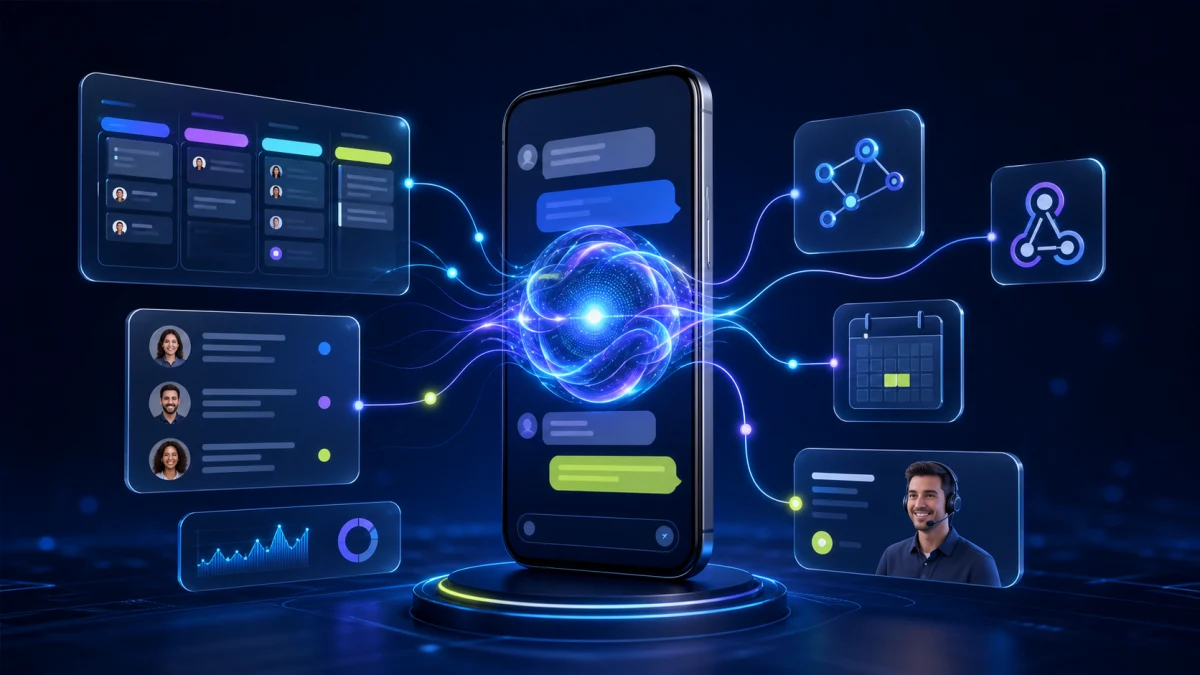
Meta AI has ceased to be an isolated novelty to occupy an increasingly central space in WhatsApp. It helps write, search, create and interact without leaving the app. At the same time, Meta is moving forward with business-oriented agents, able to answer questions, recommend products, qualify leads and mark commitments.
This does not mean that WhatsApp has become a complete CRM. It means that the consumer has started to compare the attention of a company with quick, natural and available AI experiences all the time.
Target AI raises expectations. The CRM transforms that expectation into a commercial process, history, responsibility and revenue.
What really changed in WhatsApp in 2026
The change takes place in two different layers, and confusing them leads to bad decisions.
1. Meta AI was more present for the user
Meta AI is integrated into the experience of the application for personal tasks. In 2026, WhatsApp also announced AI features to suggest answers and edit images. In May, the company presented the Anonymous mode of conversation with Meta AIprocessed in a private and temporary environment.
For the client, this makes the conversation with AI a daily thing. The person gets used to writing in his or her own way, asking incomplete questions, changing the subject and receiving an answer in seconds.
2. Meta has expanded its business-oriented AI
In June 2026, the Target presented the Meta Business Agent. Según el anuncio oficial, el agente puede responder preguntas específicas sobre la empresa, recomendar productos, reservar horarios, calificar leads, completar ventas y permitir que una persona asuma la conversación.
Meta also announced a platform to connect these agents to business infrastructure and external systems. It is a clear signal: the dispute stopped being only by automatic responses and became Agents capable of performing the work.
Meta AI, business agent and CRM are not the same
A general-purpose AI helps the user in various matters. A business agent knows the products, rules and objectives of a business. The CRM, in turn, keeps and organizes the whole relationship.
In practice, each layer solves a problem:
- Target AI: general assistance for those using implementation;
- Business agent: automated care for a specific commercial purpose;
- CRM: record, history, funnel, responsible, tasks, automations, metrics and integration with the operation.
An answer can be excellent and still not generate sales. This happens when no one registers interest, the lead does not enter the funnel, the tracking is not created, the seller does not receive the context or the result does not appear in the report.
What changes for API integrations
For companies that use WhatsApp connected to systems, the evolution of AI increases the importance of a well-defined architecture. API and webhooks remain the bridge between conversation and the rest of the operation.
It is by this bridge that the company can:
- create or update a contact when a message arrives;
- identify the origin, campaign, product and stage of the funnel;
- consult stock, schedule, order, contract or collection;
- activating automation in another system;
- record the response and return the context to the assistant;
- Measure conversion, response time and cause of loss.
The value of integration is not in putting a robot into WhatsApp. It is in allowing conversation to produce a reliable action in the business.
Why Native AI Increases the Importance of CRM
The more natural the conversation, the greater the need for organization behind the scene. Without CRM, each message seems to be a new focus. With CRM, the company recognizes the person, understands the stage of opportunity and chooses the next action based on history.
The proper commercial context
The CRM knows information that a generic AI should not guess: what proposal has been sent, who is responsible, what products are of interest to the lead, what has already been combined and why a negotiation has stopped.
Shared memory between AI and team
The history cannot get caught in the agent. When a human assistant assumes, he needs to receive summary, intent, collected data and next steps. When AI resumes, he must respect what the team recorded.
Post-response process
Answering is just the beginning. A sales operation needs to create tasks, schedule meetings, change steps, distribute opportunities, track and follow the closing.
Measurement and improvement
Without operational data, the company knows that the AI talked, but it doesn't know if it qualified well, how many attentions demanded transfer, what objections appeared and how much it became revenue.
How FunnelOps connects AI, attention and sales
FunnelOps was built for channels, AI agent and commercial funnel to work in the same operation.
- All-channel input: centralizes WhatsApp, Instagram, Facebook and other shared history contact points;
- CRM in Kanban: organises opportunities by stage, responsible, origin, labels and custom fields;
- AI Agent: Responds, qualifies, programs, summarizes and transfers attention using the context configured by the company;
- Automation and Chatbot: combine natural language with flows, conditions, buttons, waits and actions;
- Automatic tracking: prevents an interested lead from disappearing after the first conversation;
- API and Webhooks: connect the CRM to agendas, payments, ERPs, e-commerce and own systems;
- Human team: Take complex cases without starting the conversation from scratch;
- Panels: shows volume, productivity, funnel and result of the operation.
Therefore, the AI ceases to be just a response interface and becomes involved in a controlled trade flow.
Four applications that go beyond answering questions
Leads Rating
The agent understands the objective, collects the essential data, identifies the grip and places the opportunity in the right step. The seller receives a brief and more ready conversation to move forward.
Programming
With the integrated schedule, the AI can show available times, schedule the meeting and record the appointment in the contact. Automation sends confirmations and reminders without depending on manual change.
Sales and recovery
The CRM accompanies the proposal, interest and inactivity. If the trade gets cold, the tracking uses the right context. If the customer responds, the conversation returns to the team with all the history.
Collection and after-sales
The transaction can connect maturity, payment links and confirmations to the service. After purchase, the same history helps support and relationship to treat the customer as a continuity, not as a new number.
The new standard of experience
Rigid menus are still useful for predictable tasks, but they can no longer be the only gateway. Those who talk with AI daily expect the company to understand natural phrases like . .I want to reschedule . .What was the plan I saw yesterday? . . or send the proposal again .
A good experience combines three modes:
- AI to understand: He interprets intent and context in natural language.
- Automation to run: Perform predictable actions with reliable rules and data;
- person to decide: Take over negotiation, exception, claim or sensitive situation.
Privacy and governance care
An intelligent experience cannot exceed what the customer has authorized. The company needs to define which data the agent can consult, how long they are kept, who accesses the history and in which situations the conversation should be transferred.
It is also important:
- do not send unnecessary sensitive data to the AI model;
- validate price, time, availability and policy in controlled sources;
- prevent AI from inventing discounts or conditions;
- record actions relevant to the audit;
- Maintain opt-out and contact preferences;
- Follow-up of the platform's policies and technical changes.
Checklist to prepare your operation
- all channels and historical sites are centralized;
- the funnel has well-defined stages and responsibility;
- AI receives updated content on products and rules;
- critical actions consult real data instead of relying on free text;
- the transfer to a person preserves the context;
- the monitoring is created and interrupted at the appropriate time;
- APIs, webhooks and integrations have monitoring;
- Conversion and quality are measured, not just volume of messages.
The opportunity for businesses
Meta AI in WhatsApp does not eliminate the need for specialized solutions. It makes more evident what the customer expects: speed, natural language and availability.
The competitive advantage appears when the company adds that experience to something that is its own: organized data, business process, customer knowledge, own automations and a team capable of entering the conversation at the right time.
It is exactly in this layer where FunnelOps acts. The platform connects attention, CRM, AI and integrations so that each conversation has context, next step and real possibility to become a business.
Do you want to turn conversations with AI into organized opportunities?
Meet FunnelOps and see how to centralize channels, qualify leads, automate tracking and keep your team in control.
Talk to a specialist →Published by the team FunnelOps · 06 Jul 2026