
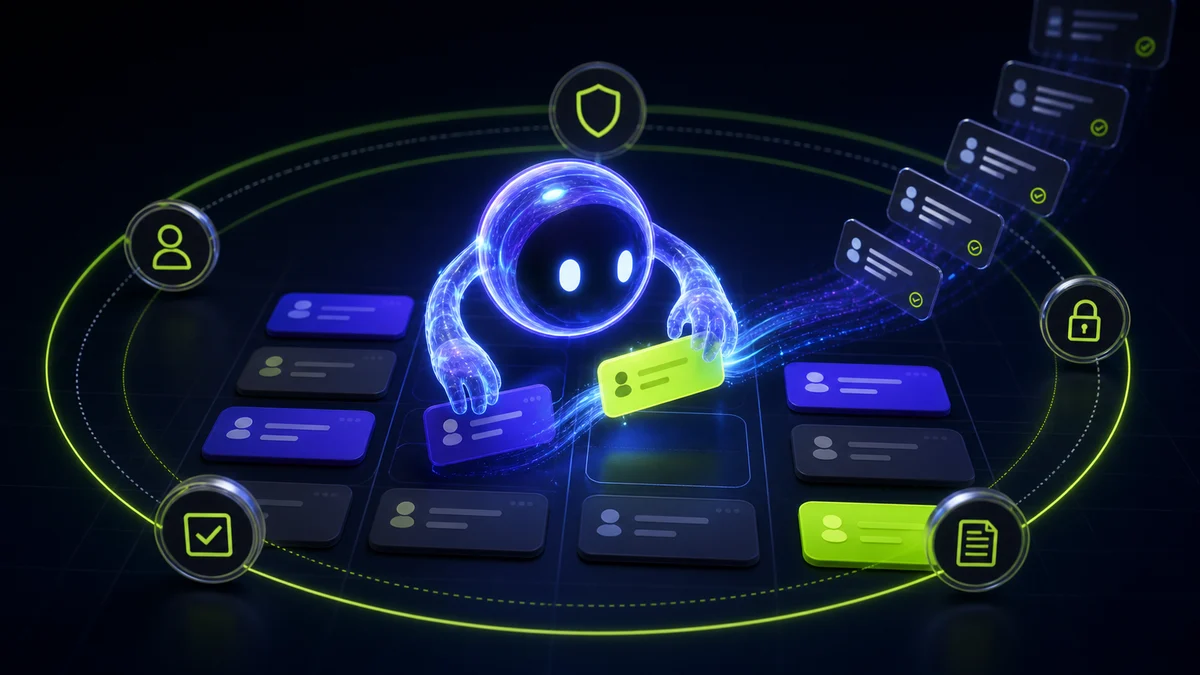
Business software has always been designed for people to click on screens. Now, AI agents begin to consult logs, update logs, and activate routines directly. A Microsoft WorkLab article published in April 2026 summarizes the change: some of the biggest software users can stop being human.
For the CRM, this changes the architecture and management. The question is not just which screen will the agent see? . . . . . . what data and actions can be accessed, with which limits and how will each decision be audited? .
Interfaces for people, tools for agents
People need menus, filters and views. Agents work better with structured tools: finding contacts, listing opportunities, creating tasks, updating step. Each tool must have well-defined inputs, outputs and permissions.
This does not make the human interface less important. On the contrary: sellers and managers should see what the agent has done, correct data and take on cases when necessary.
Intent and risk permit
Giving the agent the same access as an administrator is an error. The lowest privilege principle also applies to AI. A rating agent can read conversations and suggest steps, but does not need to delete contacts or change settings.
- Reading: access only to the necessary context;
- Suggestion: AI recommends and one person confirms;
- Reversible execution: create a registered task or label;
- Sensitive action: Discount, charge or exclusion always under approval.
Data prepared for two types of users
The ambiguous fields are bad for people and worse for agents. Steps need criteria, the state must have a unique meaning and duplicate records must be treated. The more structured the CRM, the less likely the AI will be to misinterpret.
Audit is no longer optional
Each relevant action must record the author, the time, the origin, the data used and the result. When there is a human correction, it can also feed the improvement of the flow. Without history, the company cannot explain what happened or identify error patterns.
Checklist to introduce agents
- Create a separate identity for each agent;
- Range limit by function and equipment;
- Start with reading and suggestion.
- Define actions that require confirmation;
- Keep records and review samples;
- Offer immediate interruption and transfer.
Conclusion
When agents move to operate the CRM, governance becomes part of the product. The company that prepares permits, data and audits succeeds in automating with confidence. The one that connects only one model to all systems transforms speed into exposure.
Source consulted
Microsoft WorkLab When software is biggest users aren is human
Published by the team FunnelOps · Apr 30 2026