
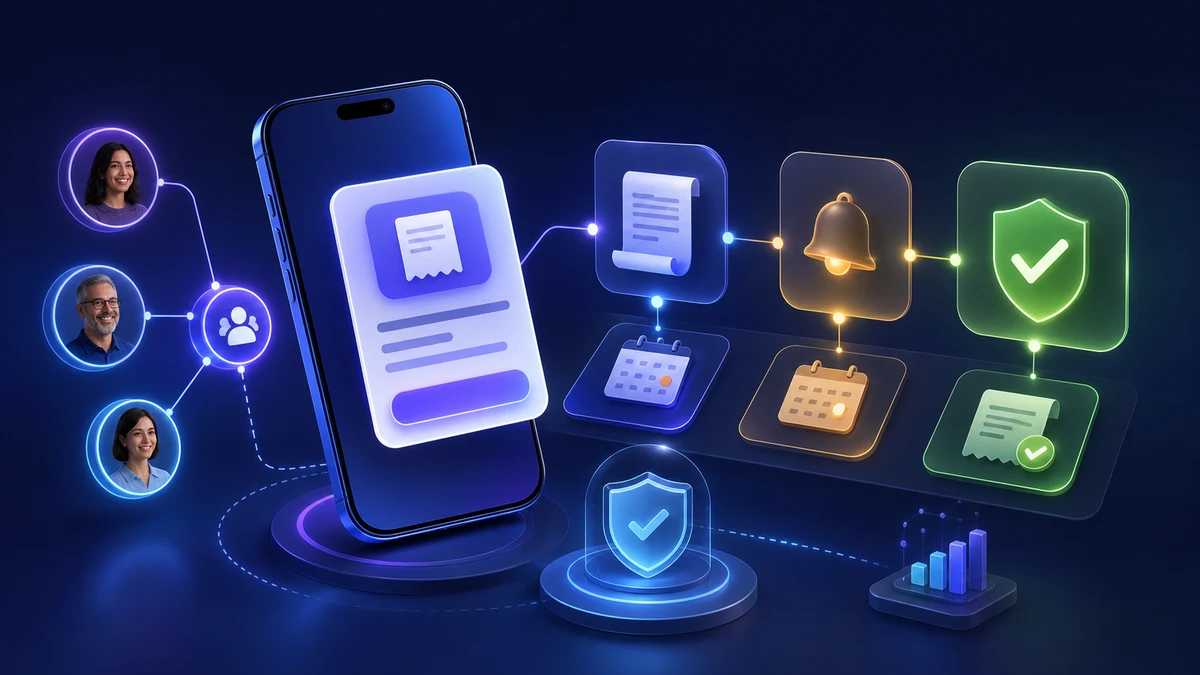
Covering by WhatsApp seems simple: locating who is to be located, writing a message and sending the link. The problem arises when the company tries to scale this process with spreadsheets, isolated shipments and different people controlling payments. The customer can receive the wrong collection, be remembered after paying or receive messages too soon.
Secure automation starts before shipment. It depends on consent, reliable data, proportional sequence, integrated means of payment and an indispensable rule: paid, the flow needs to stop.
No tool can promise zero risk of restriction. What reduces risk is a customer-anticipated, policy-compatible operation, monitored and connected to the actual status of the charge.
Why the CRM is the basis of automatic collection
A shipment robot knows a number and a message. A CRM knows the relationship: who the customer is, what he hired, when he wins, how much he is open, what contacts have already happened and whether the payment has been confirmed.
This difference avoids four common problems:
- Double charge: two areas address the same person without sharing history;
- Out of context message: the customer receives a generic text that does not identify the procurement;
- reminder after payment: the financial received, but the automation was not found out;
- Overfrequency: Each sheet creates its own sequence and no one sees the total contacts.
When the collection, conversation and payment live in the same flow, the company can automate without losing context and the assistant can assume the trade with the full history.
What WhatsApp requires of a responsible operation
A WhatsApp Business Message Policy It states that the company should only contact the person who provided the number and authorized to receive communications. It also requires that requests for departure be respected and prohibits surprise, deception or spam.
In the official API, a conversation initiated by the company must use an approved template. After the customer sends a message, free answers can be made within the 24-hour customer service window; outside it, the shipment is re-dependent on the approved template.
For the charges relating to the commercial relationship itself, the message must be presented as an update of service: objective, linked to a real procurement and without promotional content disguised. Debt recovery operations for third parties or regulated sectors require a specific evaluation of policy and legislation.
Six pillars to reduce the risk of blockage
- Verifiable consent: record when, where and for which message categories the customer authorized the contact.
- Clear identification: Tell him who's talking, what the position is, and how the client can confirm the legitimacy of the channel.
- Appropriate staffing: In the official API, use the approved and mapped model for that event, especially outside the 24-hour window.
- Proportional frequency: setting up few useful contacts. Having eight available moments does not mean that all should be activated for each client.
- Output and human attention: Respect requests to interrupt reminders and offer a clear route to negotiate or challenge.
- Synchronised download: connect the link door to the CRM to stop the flow as soon as payment is recognized.
How the FunnelOps Collections module works
The module was built within the CRM to connect log, conversation, payment and financial tracking. The company does not need to maintain one tool to collect and another to find out who has already paid.
1. Customers and products already organized
CRM contacts can be imported into the billing portfolio. Each customer brings together telephone, email, company, CPF or CNPJ, open, backward and received values, as well as billing history.
The products and services use the same CRM record. When selecting an item, the value can be automatically filled, keeping the consistency between what has been sold and what will be charged.
2. Single payment the recurring
The charge can be avulsive, weekly, monthly or annual. The company defines customer, product or service, value, title, description and first maturity. In recurring plans, each cycle generates its own invoice and, after confirmation of payment, the next maturity is programmed.
3. Payment link by the chosen link door
The module integrates Asaas, Market Payment, InfinitePay and Stripe. Dependiendo de la puerta de enlace, el cliente puede recibir opciones como Pix, boleto, tarjeta o cuota. El dinero va a la cuenta configurada por la propia empresa.
CRM sends a payment link instead of asking for sensitive data in the conversation. This reduces friction and prevents full card or account numbers from being processed by message.
4. configurable reminder sequence
The company chooses the moments that make sense for its operation:
- when the charge is created;
- seven, five, three, or one day before maturity;
- on the same day as the salary;
- One, three or five days after the delay.
It is also possible to set the shipping schedule and a default connection. The best start is usually a loose sequence, expanded only after analyzing responses, payments, locks and exit requests.
5. Official API with templates per event
When the default connection uses the official API, the module allows you to update the list of approved templates and map which template will be used in each event: billing or reminder and confirmed payment.
Variables enter real data such as client, title, value, maturity, and link. This avoids loose text, reduces manual errors, and keeps the message compatible with the approved template.
6. Automatic lowering and confirmation
After payment, the link door sends a notification to the CRM. The invoice is marked as paid, the sequence stops charging that maturity and a confirmation can be sent automatically. If it is a recurring charge, the next cycle is created.
Payments received from outside can also be dialed manually. The history records what happened and the runway records help to investigate notifications that did not produce the expected drop.
A respectful collection sequence
The rate should reflect the type of contract, ticket and relationship. A balanced example for monthly payments may be:
- D3: Preventive reminder, with value, date and link;
- D0: notice of expiry, direct and cordial;
- D+1: query message asking if there was any difficulty;
- D+5: guidance for regularisation or negotiation;
- Payment confirmed: Thank you and automatic closing of the cycle.
There is no universal sequence. Business customers, low value subscriptions, clinics and high ticket services have different expectations. CRM allows you to segment the strategy and follow the result before increasing frequency.
Message templates that help instead of pressing
A good message contains enough context to be recognized, but it does not expose sensitive information.
Before due date
The monthly title, worth value, expires in due time. To make it easier, payment can be made for this secure link: link. If you need help, please reply to this message.
First day of delay
Hello, name. We do not identify the payment of title, with maturity in maturity. Has there been any difficulty? You can regulate by link or talk to our team here.
Payment confirmed
Payment of title, value, confirmed. Thank you, name. Everything is fine here.
Avoid threats, excessive letters, artificial urgency and information that the client did not expect to receive. For sensitive matters, please refer the person to an authenticated area or an assistant.
Reports to improve recovery
Unmeasured automation only accelerates a bad process. The module brings together indicators of receipt, receipt, default, receipt rate, MRR, average ticket and active subscriptions.
It also shows the monthly evolution, the distribution by state, the customers with the highest open balance, the products with the highest income and the results per gateway. Data can be exported to CSV for analysis or accounting.
These numbers help to answer practical questions: what reminder brings more payments? When do blockages increase? What product concentrates delays? Which link door has more confirmation failures?
And the charge created by the AI Assistant?
In FunnelOps, the AI Assistant may receive permission to generate a charge during the conversation itself. When the client decides to close a plan or service, the AI uses the product, value, contact and link port configured in the CRM to create and send the link.
The AI should not invent price, maturity or condition. It collects on the basis of authorized data and rules. Cases of doubt, dispute or negotiation should continue to have a clear path for the human team.
Checklist before automating
- the customer has authorized receipt of billing messages by WhatsApp;
- the number, contract, value and maturity are correct;
- the default connection is active and belongs to the company;
- the official templates are approved and mapped;
- the sequence has a frequency compatible with the relationship;
- opt-out is respected in all automations;
- the payment link uses the correct link door;
- the confirmation webhook has been tested;
- there is human attention for doubts and negotiations;
- Blockages, complaints, failures and payments are followed.
Better to collect is to facilitate payment
The best automation is not the one that sends more messages. It is the one that delivers the right reminder, at the right time, with the right link and closes the sequence as soon as the customer pays.
By placing the charge within the CRM, the company gains context, traceability and control. Financial reduces repetitive tasks, service recognizes customer history and management sees default and recurring revenues in one place.
Do you want to automate your billing within the CRM?
Learn the FunnelOps Collections module with reminder sequences, payment links, automatic download, reports and integration with the service.
Talk to a specialist →Published by the team FunnelOps · 17 Jul 2026