
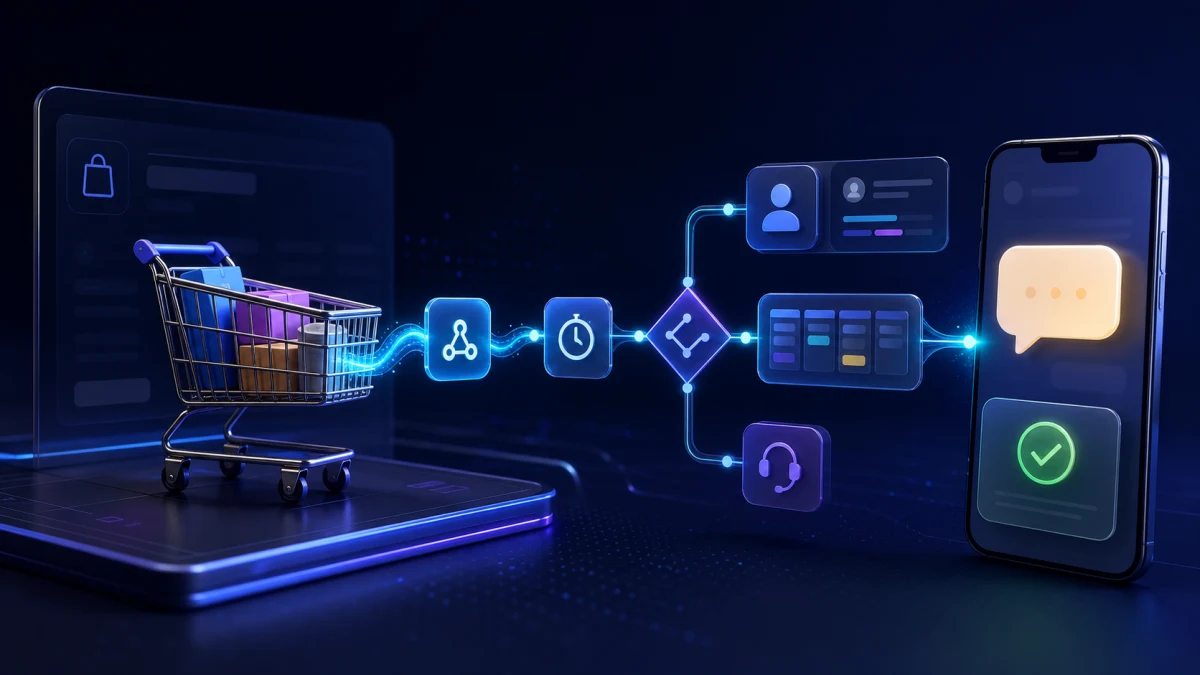
The abandoned cart is one of the biggest revenue leaks from e-commerce. The customer saw the offer, chose a product and advanced on the trip, but left before completing. Baymard Institute A documented average of 70.22% abandonment based on 50 studies is calculated.
Not all abandonment means lack of interest. Unexpected shipping, long term shipping, doubt about size, lack of payment, insecurity, distraction or price comparison can disrupt a purchase that still has a chance to happen.
Recovering a car is not insisting on who has surrendered. It is identifying the intention, offering help and removing friction before interest cools.
WhatsApp can overcome emails and SMS
The email, SMS and WhatsApp have different roles. The email has more visual content and works well for further reinforcements. The SMS is fast and direct. WhatsApp, however, has a decisive advantage: Recovery can become a conversation.
Email: complete but less immediate
An email message can show products, benefits, reviews and recommendations. The problem is that it depends on the customer opening the inbox, finding the content between promotions and clicking to return to checkout.
SMS: fast, but with little context
SMS works as a short reminder and can be useful as an alternative channel. But it has less space to explain the sending, deadline, exchange, plotting or any objection that requires dialogue.
WhatsApp: context, response and continuity
In WhatsApp, the customer can answer . . the shipment was made expensive . . I did not find my size . . the card did not pass . . The company stops sending only one reminder and comes to understand why the sale stopped.
That's why WhatsApp tends to overcome email and SMS in many recovery streams: not only does it attract attention, but it allows you to solve the objection in the same environment.
The webhook is the sign that something has happened
To get the cart back at the right time, the CRM needs to know that it was abandoned. That's where the webhook enters.
A webhook is a notification sent automatically by a system when a particular event occurs. Instead of the CRM checking the store every minute asking if there was an abandonment, the e-commerce sends the data as soon as the condition is identified.
A car event can load:
- customer name and telephone number;
- Articles and quantities;
- total value;
- link to resume checkout;
- time of the last activity;
- origin or campaign;
- Car I.D.
In FunnelOps, an external store can send this event to a webhook end point of the workflow. The payload enters the CRM, can create or locate the contact and is available for the next automation steps.
FunnelOps Native Abandoned Cart Activator
For shops and menus built on the My Site module, FunnelOps has Activators ·Abandoned cart on site. Cuando hay suficiente teléfono, elementos e inactividad, el sistema identifica o crea el contacto, registra el carrito y coloca el evento en la cola de flujos de trabajo.
The event delivers to the flow information such as client, phone, items, total and time of inactivity. Therefore, the message does not need to be generic and recovery is already born connected to the CRM registry.
There are also events of request created And Change of status of application. Permiten finalizar la recuperación cuando se realiza la compra e iniciar un nuevo viaje de confirmación, pago, separación o entrega.
Workflow: what happens after webhook
Receiving the event is only the beginning. The workflow decides what to do, in what order and what paths to follow according to the customer's reaction.
The Visual Editor of FunnelOps allows you to combine blocks like:
- Map fields: carries elements, total, link and origin to the record or to flow variables;
- Text with AI: create a custom message from the authorized data;
- Delay: Wait before the next contact.
- Condition: separate paths by value, product, response or profile;
- Wait Event: pause until a purchase, response or other event occurs, with an alternate exit for time out;
- Add Tag: It identifies contacts such as abandoned cart or recovered;
- Create an agreement and move in Kanban: transforms the intention into an accompaniable opportunity;
- HTTP request: consult or update a store, ERP, checkout or own system;
- AI Assistant and Transfer: He answers questions and sends complex cases to a person.
A Practical Flow of Recovery Work
1. Receiving abandonment
The native activators or the webhook of the store informs that the cart has stopped. The CRM receives the customer, the elements, the total and the identifier of the trip.
2. Validate data and consent
Before shipment, the workflow confirms if there is a valid phone, authorization to receive messages and a cart still open. If the purchase has already been completed, the stream ends.
3. Mapping the Context
The mapping block organizes product, value, link, origin and other information. A tag can identify the entry and an agreement can be created in Kanban when the strategy requires commercial tracking.
4. Sending a first useful approach
The first message should open up space for help:
Hello, name. I saw you left items in the cart. Did you have any difficulty finishing or can I help with shipping, delay or payment?
The goal is not to press. It is to discover the barrier and to give a simple way to continue.
5. Waiting for customer action
The workflow can wait for an answer or the order event created. If the client buys, the sequence closes and the contact receives the recovered tag. If the conversation responds, the conversation follows AI or human attention. If the deadline ends without action, the stream advances to a new reminder.
6. Make a second proportional contact
After a few hours, a new message can reinforce the link or remove a common objection:
Your cart is still available. If you want to finish, you can come back here: link. If there are any questions left, just answer them.
7. Close sequence
A third attempt only makes sense when there is relevance and consent. After that, the flow must end. Excessive repetition generates opt-out, blockage and loss of confidence.
Why to wait Event is better than just putting a delay
A blind delay expects time to pass and continues, even if the customer has already bought it. Wait Event Allows the workflow to react.
Imagine a four-hour wait:
- if the request is created in 20 minutes, the flow continues along the way . . . happens and interrupts messages;
- If there is no purchase, it continues along the way. Time is exhausted and it evaluates the second reminder;
- If the customer responds earlier, automation can transfer the conversation or activate the AI.
This difference reduces messages out of time and converts the sequence into a process based on actual behavior.
How AI Helps Without Looks Like Surveillance
The AI can adapt the answer to the objection. If the customer asks about size, term, exchange or plotting, the agent consults the authorized basis and answers naturally. If the question requires a commercial decision, the staff takes charge.
Customization should use only the necessary context. ☆Leave the product X in the cart ☆ can be useful. Mentioning old habits without need can seem invasive.
In FunnelOps, o Text with AI can generate the message within the workflow, while the AI Assistant Both must work with product rules, discount limits and transfer established by the company.
WhatsApp does not fix a bad checkout
Recovery helps to identify bottlenecks, but does not replace the trip correction. If most answers speak of freight, term or payment, the problem is in the checkout not in the message.
Register the reasons for dropping out on the CRM tags or fields and take this information to management. The workflow can recover sales today and at the same time show what needs to be improved to reduce the drop out tomorrow.
Consent, templates and human attention
A WhatsApp Business Message Policy requires that the company has received the number and consent of the recipient. It also determines that requests for departure are respected.
In the official API, the conversations initiated by the company depend on an approved template. Free messages can be used within the customer service window 24 hours after a user message; outside it, the shipment again depends on the template.
Automations must offer a clear path for human attention. In recovering the car, this is especially important when there is complaint, doubt of payment, negotiation or cancellation request.
Metrics showing whether the workflow works
- recovery rate: orders recovered cars impacted;
- Revenues recovered: the sum of the applications allocated to the flow;
- response rate: How many customers have started a conversation?
- Step conversion: What message really generated purchase?
- time to recovery: interval between abandonment and application;
- Reason for abandonment: shipment, term, payment, product or other;
- opt-out and locks: Signs of frequency or inappropriate approach.
The most important indicator is not how many messages were sent. It is how many revenues were recovered without damaging the experience and health of the channel.
Checklist to put recovery in production
- the telephone and consent are collected prior to abandonment;
- the event loads the correct cart, articles, value and link;
- webhook has bug authentication and registration;
- the working flow does not trigger the empty cart or the completed order;
- messages use real data and useful language;
- the official model is approved when necessary;
- there is a waiting for the purchase event before the next reminder;
- AI and the human team have defined responsibilities;
- opt-out immediately closes the communication;
- Income, response, conversion and motives are accompanied.
From the parked cart to the next step
WhatsApp wins email and SMS when recovery needs dialogue, speed and resolution of doubts. But the result depends on what happens behind the message.
With webhook and workflow, the company knows which cart was stopped, organizes the contact in the CRM, sends a contextual approach, waits for the reaction, involves AI or seller and closes the sequence when the purchase occurs.
In FunnelOps, this trip can be built in one environment: abandoned cart activators, webhooks, visual workflows, CRM in Kanban, artificial intelligence, human attention and metrics of the operation.
Do you want to recover carts with a working flow connected to the CRM?
Know FunnelOps and see how to convert events from your e-commerce into conversations, opportunities and recovered sales.
Talk to a specialist →Published by the FunnelOps · May 01, 2026