
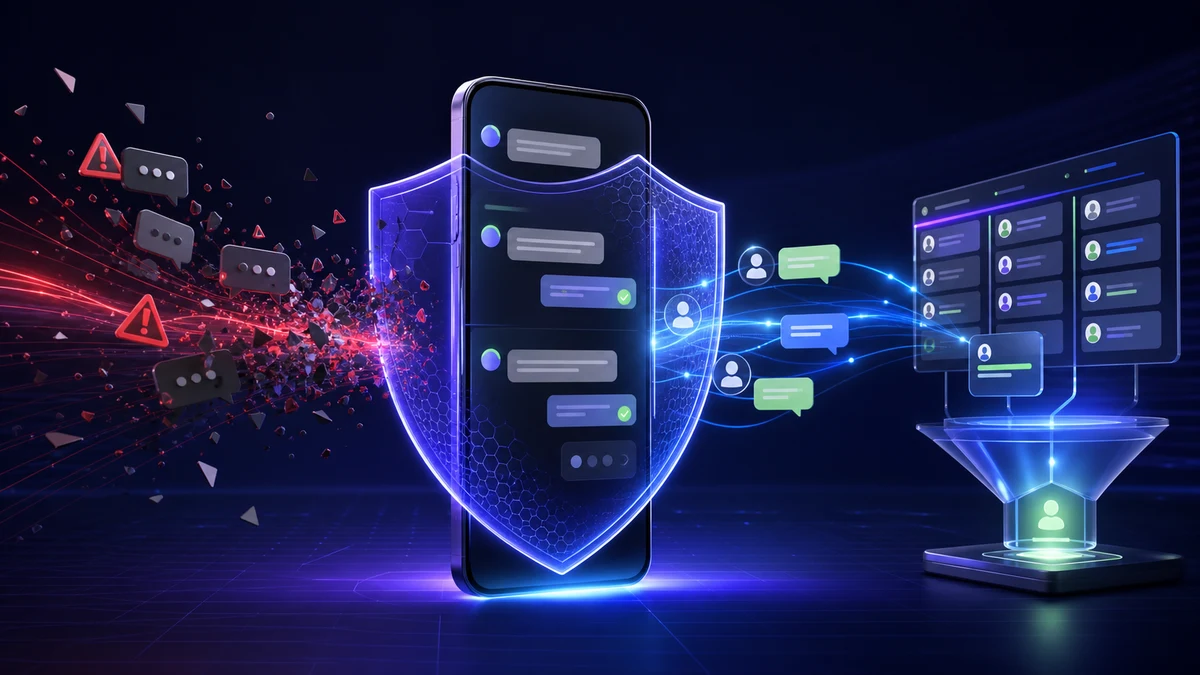
When WhatsApp concentrates attention, sales, support and billing, a blockage is no longer just a technical problem. It can interrupt ongoing conversations, delay responses, reduce revenues and shake the confidence of customers who use that number as the company's main channel.
The most important thing is to understand that The ban is usually not explained by a single shipment. La plataforma evalúa las políticas, el comportamiento de operación y la reacción de los usuarios. El consentimiento frágil, muchas denuncias, mensajes inesperados y la falta de control sobre las campañas forman un escenario de riesgo.
What the ban means in WhatsApp
Prohibition is the loss of access of an account to WhatsApp services. Before reaching a definitive measure, the company may also face shipping limitations, paused message models, fall in quality, temporary restrictions or a suspension subject to analysis.
In practice, the effects depend on the product used, the type of violation and the account history. Therefore, the best plan is not to try to discover a secret limit, but to operate in a way that every message is expected, relevant and compatible with applicable policies.
There is no configuration capable of ensuring zero risk. There is a well-managed operation that reduces exposure, identifies early signals, and reacts before a problem grows.
Why a company can be restricted
The WhatsApp Business Message Policy allows you to limit or eliminate access when there is a violation of terms, harm to users or relevant volume of negative feedback. Among the factors that deserve attention are:
- Contact without consent: the person did not provide the number or authorized to receive such a message;
- Unexpected Messages: the content, frequency or sender does not correspond to what was promised at the time of accession;
- Blocks and complaints: Negative reactions indicate that experience is not perceived as useful.
- Unauthorized mass delivery: The bases purchased, the old lists or campaigns without criteria increase the chances of rejection.
- Prohibited or misleading content: Offers, products and approaches must respect trade and messaging policies;
- Human output automation: flows that catch the customer, repeat messages or do not offer scaling harm the experience;
- Lack of internal control different equipment and integrations can send to the same contact without sharing history, preferences and limits.
Seven practices to protect the operation
- Register consent: keep origin, date, purpose and authorized categories. A record is not synonymous with permission without restrictions.
- Explain what will be sent: make it clear if the person will receive updates, reminders, support or offers. The smaller the surprise, the smaller the rejection.
- Facilitates the exit: provide a simple way to stop receiving and immediately comply with requests made within or outside WhatsApp.
- Segment before sending: Interest, stage of the funnel, last interaction and relationship with the brand must define who actually receives the campaign.
- Frequency control and overlap: centralizes campaigns and automations to prevent a person from receiving repeated messages from different areas.
- Quality monitoring and reaction: Tracking locks, complaints, bugs, answers, opt-outs and performance changes by audience and message.
- Have review and responsibility: Define who approves campaigns, who can import contacts, and who pauses an automation when a risk signal appears.
Is high volume always the problem?
Volume, by itself, does not tell the whole story. A notification expected by thousands of customers can generate less rejection than an offer sent to a small base that never authorized that contact. What matters is the combination between public, context, content, cadence and user response.
This does not mean that climbing quickly is indifferent. Sudden increases make reading of signals difficult and increase the impact of an error. Safer growth occurs in stages, with controlled groups, pause criteria and comparison of results before expanding.
How the CRM reduces operational risk
A dedicated CRM helps to turn good intentions into verifiable controls. Instead of relying on computer spreadsheets and memory, the company can maintain:
- origin and status of consent in each contact;
- deletion lists and communication preferences;
- background of campaigns, responses and exit requests;
- segments based on actual relationship data;
- Frequency limits and rules against duplicate messages.
- permits for the import, creation and approval of campaigns;
- Indicators of delivery, interaction, failure and rejection.
Centralizing these signals allows to interrupt a campaign with problems without paralyzing the entire operation. It also makes it easy to find out if the cause is in a specific base, message, automation or stage of the trip.
What to do when receiving a restriction
The first step is Stop repeating the behavior that may have caused the problem. Suspender las campañas relacionadas evita aumentar el volumen de comentarios negativos mientras el equipo investiga.
- record the schedule, the displayed notices and the assets affected;
- Review recent campaigns, origin of lists, consents and departure requests;
- Verify quality alerts and resources in official management environments;
- correct the process before requesting a review;
- Use only the official resource channels indicated by WhatsApp or Meta.
- Don't try to avoid the restriction by recreating the same operation in another number.
A well-founded resource should explain the context, present the corrections made and demonstrate how the company will avoid recurrence. There is no guarantee of reversal, but evidence and governance make the analysis more objective.
Preparing a Continuity Plan
Even a careful operation must be prepared for unavailability and revisions. Keep alternative channels diffused, important contacts registered with the CRM, incident managers and a communication ready to guide customers without exposing internal details.
WhatsApp may be the main channel, but it should not be the only place where the company's relationship, history and business intelligence live.
Protect the channel without blocking its sales
Centralize consents, histories, campaigns, automation and attention in an operation with more control and traceability.
Talk to a specialist →Published by FunnelOps · Mar 10 2026